
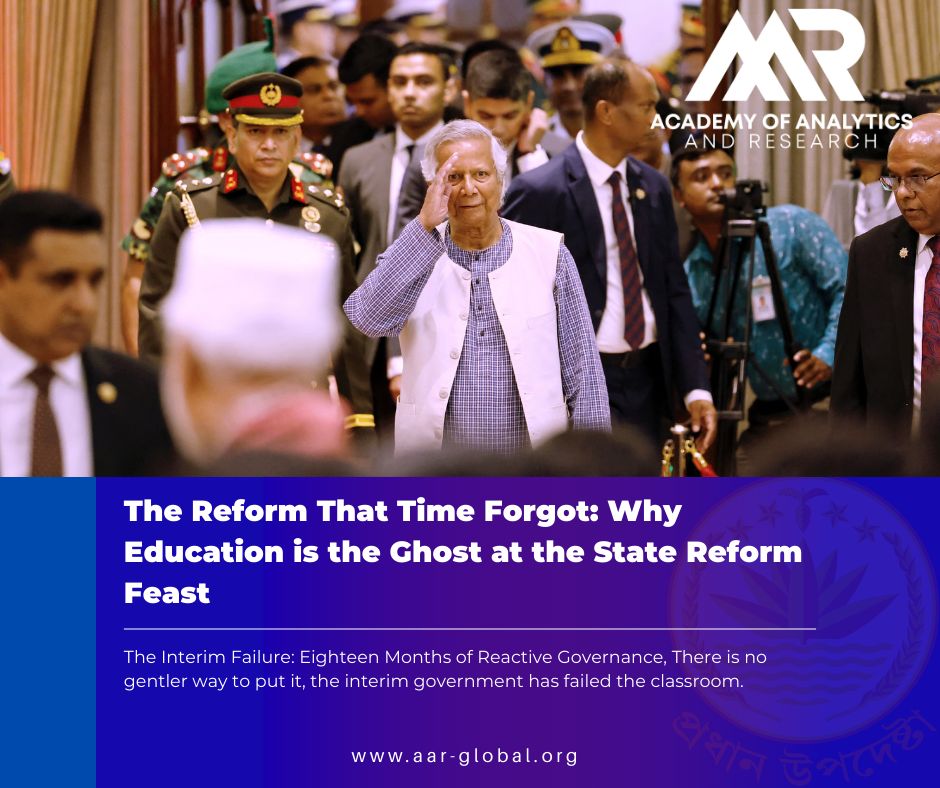
Why Education is the Ghost at the State Reform Feast, The Interim Failure: Eighteen Months of Reactive Governance.
There is no gentler way to put it, the interim government has failed the classroom. They had the time, the mandate, and the moral authority to be radical, yet they chose to be reactive. While 11 separate reform commissions were established for sectors ranging from the judiciary to the police, education was treated as a routine administrative burden.
For an administration led by a world-renowned academic, the refusal to constitute an Education Reform Commission is a staggering irony. The interim setup had eighteen months to dismantle the “Political VC” culture and institutionalize merit-based leadership. Instead, they allowed a power vacuum to persist, leaving our universities in a leaderless limbo for months.
We witnessed the “HSC-auto-pass” fiasco repeated under street pressure, chronic textbook delays that left students without books well into the academic year, and a budget that remains a global outlier, bottoming out at a shameful 1.69% of GDP in the FY2025-26 proposal. By failing to provide a clear framework, the interim government has essentially left our youth in a state of pedagogical paralysis.
The Looming Shadow: Will the Next Administration Care?
The most terrifying question facing the 56 million young citizens of Bangladesh today is not who will win on February 12, but whether the winner will have any incentive to fix the mess.
History in Bangladesh is a repetitive cycle where education is the first sector to be “politicized” for recruitment and the last to receive genuine investment. There is a high risk that the next elected government will view the current leadership vacuum not as a crisis, but as an opportunity to install their own loyalists. If an unelected interim government unburdened by the need for immediate votes could not muster the courage to overhaul this sector, what hope is there for a partisan government focused on the next election cycle?
Why This is a “State Emergency”
Stakeholders must realize that by the end of 2026, Bangladesh will navigate a pivotal transition out of the Least Developed Country (LDC) category. Our preferential trade deals will vanish. Our only remaining resource is the skill of our people. If the next administration continues this pattern of neglect, our “Demographic Dividend” will officially become a “Demographic Disaster.”
“A nation that cannot lead its classrooms cannot hope to lead its economy. The blood spilled in July 2024 was for a nation where merit is the only currency. If we do not demand a roadmap now, we are merely preparing our youth for global irrelevance.”
The interim government has missed its chance to be the architect of a new educational era. As we head to the polls, the burden of proof lies with the political class. Will they finally lead the classroom, or will they continue to let it burn in the name of political expediency?