
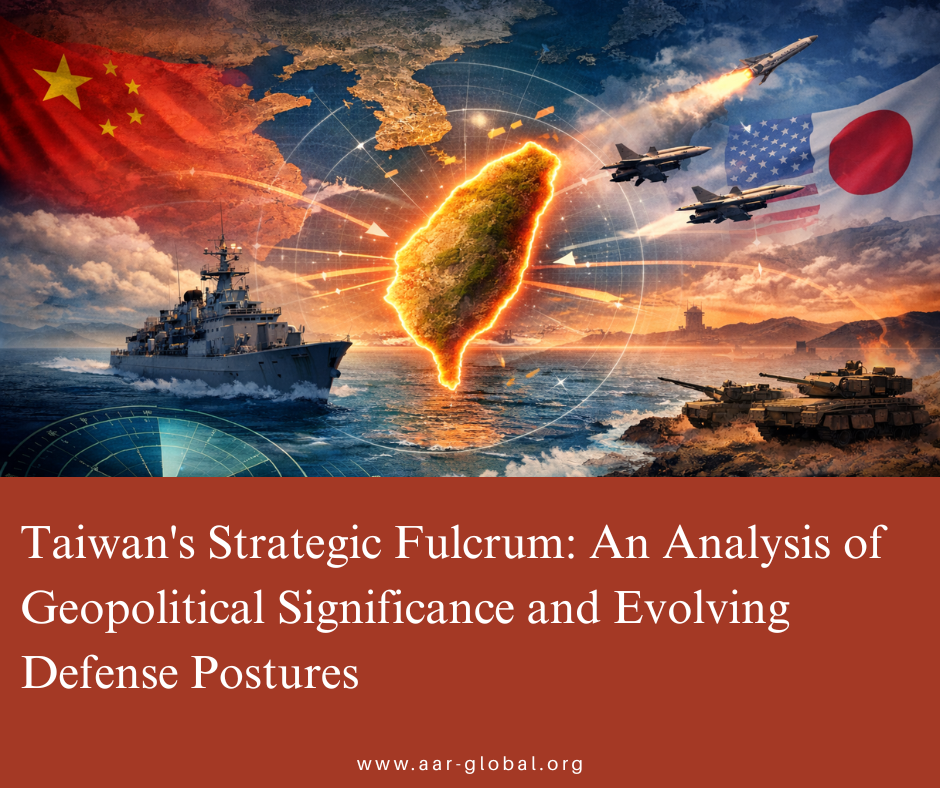
Despite its modest size, Taiwan occupies a position of outsized geopolitical importance,
serving as a critical fulcrum in the escalating strategic rivalry between the United States and China. Its location is not merely a geographical fact but a central element shaping military calculations, trade routes, and the balance of power across the entire Indo-Pacific. This section deconstructs
Taiwan’s role as a geographical and strategic linchpin, examining how its control could
fundamentally alter the security architecture of the region. The island is the most critical link in the First Island Chain (FIC), a concept central to U.S. and allied strategy in the Pacific. This strategic barrier serves as the primary line of defense and containment against Chinese military power projection.
- Composition: The chain is comprised of a series of archipelagos friendly to the United States, stretching from Japan in the north, through Taiwan, and down to the Philippines in the south.
- Strategic Function: By controlling this chain, the U.S. and its allies can effectively bottle up the Chinese navy, monitor its movements, and constrain its ability to operate freely in the wider Pacific. This posture limits China’s submarine fleet, in particular, forcing it to navigate a gauntlet of allied sensors and patrols.
A potential Chinese seizure of Taiwan would have profound strategic consequences, effectively severing the First Island Chain at its center. This would grant the People’s Liberation Army (PLA) Navy especially its expanding submarine fleet unimpeded access to the deep waters of the Pacific Ocean. Taiwan’s east coast drops off steeply near the edge of the continental shelf, offering an ideal corridor for submarines to slip into the open ocean undetected, dramatically increasing the threat to U.S. and allied naval assets and even land-based targets.
In the event the First Island Chain is compromised, the Second Island Chain serves as a U.S. strategic fallback position. Stretching from Japan’s Bonin Islands down to Guam and Western New Guinea, this secondary line of defense would be bolstered to re-establish a containment perimeter and check Chinese military expansion further into the Pacific.
Taiwan’s strategic value is further amplified by its proximity to several of the world’s most critical maritime chokepoints, which are vital for both global commerce and military mobility. This is underscored by Taiwan’s proximity to several key maritime choke-points:
| Strait | Strategic Significance |
| Taiwan Strait | A key trade route for China, Taiwan, and the world. Almost all of the world’s largest container ships pass through this narrow waterway. |
| Miyako Strait | Located between Taiwan and Japanese islands, it serves as a key strategic gateway for the Chinese navy to access the Pacific Ocean from the north. |
| Bashi Strait | Situated between Taiwan and the Philippines, this strait is a crucial access point for the navies of both China and the U.S. and an important maritime traffic route. |
This unique geography establishes Taiwan as a non-negotiable strategic asset. However, its geographical importance is magnified by economic factors that have made the island
indispensable to the global economy.
2.0 The Economic Imperative: The “Silicon Shield”
Beyond its geographic position, Taiwan’s modern strategic importance is inextricably linked to its dominance in a single, critical industry: advanced semiconductors. This dominance forms the basis of the “Silicon Shield,” a concept wherein Taiwan’s indispensable role in the global technology supply chain acts as a powerful deterrent against military aggression. This section analyzes how control over this industry has become a central pillar of Taiwan’s security and a major point of global contention.
Taiwan’s command of the global semiconductor market is overwhelming. The island produces most of the world’s microchips and, critically, 90% of the most advanced ones. This market is led by the globally renowned Taiwan Semiconductor Manufacturing Company (TSMC), whose cutting-edge fabrication plants are the linchpin of the world’s technological infrastructure.
This reality has created a profound dual dependency. The United States relies heavily on
Taiwanese chips for its advanced technology sector, from consumer electronics to the sophisticated guidance and processing systems underpinning its military. Modern, information-driven economies and next-generation capabilities, particularly in artificial intelligence (AI), are fundamentally dependent on these components.
Simultaneously, China is also reliant on Taiwan for the advanced semiconductors necessary to fuel its own economic growth and military modernization. This dependency creates an acute vulnerability. The impact of being cut off from this supply was demonstrated when Russia’s defense sector and its efforts to develop advanced AI were crippled due to a lack of access to advanced microchips following its invasion of Ukraine.
This dependency provides Taiwan with significant strategic leverage, but it also elevates the risks to global stability. For China, seizing Taiwan would not only be a political victory but would grant it an iron grip on the world’s most critical technological resource. With control over the production of the most advanced microchips, Beijing would gain massive economic leverage over the entire world, enabling it to coerce other nations and reorder the global economy to its advantage. Recognizing this vulnerability, the United States is actively implementing countermeasures to mitigate its dependency. President Biden has negotiated for TSMC to expand its manufacturing of advanced 3nm chips to facilities on the U.S. mainland. Furthermore, in a coordinated effort with Japan and the Netherlands, the U.S. has instituted a microchip ban to limit the export of advanced chips and manufacturing equipment to China, aiming to slow its development of advanced AI.
This intense economic competition over the world’s most vital technological components directly informs the military postures and evolving defense doctrines shaping the region.
3.0 Competing Military Postures and Evolving Doctrines
The escalating geopolitical and economic stakes surrounding Taiwan are mirrored by a rapid and dynamic military buildup in the region. To understand the current balance of power, it is essential to assess the capabilities and strategic goals of the PLA, the fundamental evolution of Taiwan’s own defense strategy, and the pivotal role of U.S. military support in shaping the calculus of deterrence.
3.1 The People’s Liberation Army: Modernization and Strategic Aims
Humiliated by its inability to counter a U.S. carrier strike group during the Third Taiwan Strait Crisis in the mid-1990s, the Chinese Communist Party initiated a massive military modernization effort that continues to this day. The primary goal of this buildup is to develop the capabilities necessary to achieve reunification with Taiwan, by force if necessary. The PLA’s core military strategy is centered on the concept of Anti-Access/Area Denial (A2/AD).
The objective of A2/AD is to make it too costly or too risky for U.S. forces to intervene in a
regional conflict. By deploying a formidable arsenal of long-range missiles, advanced air defenses, and naval assets, the PLA aims to control access to the military operational zone around Taiwan and threaten any enemy forces that attempt to enter it.
A key component of China’s strategy is its growing amphibious assault capability. For decades, the PLA lacked the capacity to transport a sufficient invasion force across the Taiwan Strait. However, with the expansion of its fleet of modern amphibious assault ships, it is estimated that by 2027, the PLA will possess the capacity to move the large number of troops, equipment, and supplies required for a successful landing on Taiwan.
While the PLA Navy is now the world’s largest by number of ships, it is not yet a true “blue-water navy” with the ability to project power far from its home shores. It significantly lags the U.S. in total tonnage and lacks sufficient aircraft carriers, naval aircraft, Marine expeditionary forces, and support ships. However, its fleet of cruisers and smaller vessels is well-suited for a conflict in the shallower waters of the Taiwan Strait, where it could operate under the protective umbrella of shore-based air defenses and anti-ship missiles.
3.2 Taiwan’s Defense Doctrine: A Strategic Crossroads
Taiwan’s traditional defense strategy was built on its geography. The island’s military planned to use its mountainous terrain as a natural shield, fortifying its east coast as a safe haven to refuel and re-arm its fighter jets. The primary goal was to survive an initial Chinese assault from the west coast and hold out until allies, namely the United States, could arrive. This strategy is now considered outdated. The PLA’s modernized air force can now send aircraft and drones to circle the entire island, demonstrating its capability to attack from the eastern side and eliminating the concept of a “safe” rear area. This new reality has sparked a critical debate within Taiwan’s military leadership about the best path forward, centered on two competin schools of thought.
| Asymmetric “Porcupine” Strategy | Conventional Deterrence |
| Advocated by retired Admiral Lee Hsi-Min, this strategy focuses on making an invasion prohibitively costly for the PLA. Instead of matching China’s large conventional weapons, Taiwan would invest in smaller, mobile, and widely distributed defenses like portable anti- ship/air missiles, drones, and radar systems. This approach draws parallels to Ukraine’s early success against Russia, using weapons like Stinger and Javelin missiles to blunt a larger invading force. | Supported by figures like Dr. Su Tzu-Yun of the Institute for National Defense and Security Research, this perspective directly counters the new threat to Taiwan’s east. It advocates for using limited resources to “create a so-called denial zone to blockade PLA’s navy or their air force to enter east side of Taiwan.” This requires investment in larger defensive systems, such as the Patriot missile defense system and the ship-mounted Phalanx cannon, to intercept and destroy incoming threats. |
Synthesizing these competing views, Taiwan’s Defense Ministry has officially stated that during wartime, there will be no clear distinction between the front lines and the rear, acknowledging that the entire island must be prepared for conflict.
3.3 The Role of U.S. Military Support
Direct U.S. military support remains a cornerstone of Taiwan’s defense. During the Trump
administration, a major $10 billion arms sale was announced that included crucial systems like the High Mobility Artillery Rocket System (HIMARS) and Army Tactical Missile Systems (ATACMS). These systems, similar to what the U.S. has provided to Ukraine under the Biden administration, are designed to enhance Taiwan’s ability to repel an invasion force. Strategically, the U.S. is also bolstering its regional posture. Expanded U.S. military access to bases in the northern Philippines is particularly significant. By placing assets like HIMARS in these locations, just across the Bashi Strait, the U.S. could strike back remotely against a Chinese invasion attempt without having to place its own forces in immediate jeopardy. These military dynamics do not exist in a vacuum; they are driven by deep-seated political and historical factors that have defined the cross-strait relationship for over 70 years.
4.0 Historical and Political Foundations of the Conflict
To fully grasp the current tensions across the Taiwan Strait, one must understand the historical and political context that has shaped them. The conflict is rooted in the unresolved outcome of a civil war, maintained by decades of deliberate diplomatic ambiguity, and fueled by powerful domestic narratives on both sides. This section outlines these foundational elements.
The current political division is a direct result of the Chinese Civil War, which concluded in 1949. Mao Zedong’s Communist forces were victorious on the mainland, establishing the People’s Republic of China (PRC). The defeated Nationalist forces, led by Chiang Kai-shek, fled to Taiwan and re-established their government, the Republic of China (ROC). This created two rival governments, each claiming to be the legitimate authority over all of China. This delicate situation has been managed for decades by the U.S. policy of “strategic ambiguity.” This policy is a deliberate diplomatic fudge. On one hand, the U.S. officially acknowledges the PRC’s “One China” principle, which asserts that Taiwan is part of China.
On the other hand, the U.S. maintains robust, albeit unofficial, ties with Taiwan, sells the island arms for self-defense under the Taiwan Relations Act, and has consistently stated its opposition to any unilateral change to the status quo by either side.
The PRC’s policy toward Taiwan is driven by a core political narrative centered on “national rejuvenation.” President Xi Jinping has linked the goal of reunification directly to overcoming the “Century of Humiliation”—a period in the 19th and 20th centuries when China suffered from foreign invasions and internal turmoil. From Beijing’s perspective, bringing Taiwan back into the fold is a critical and non-negotiable step in restoring China to its rightful place as a great power. The perspective of the Taiwanese populace, however, is far more nuanced and pragmatic.
- Overwhelming Preference: Decades of public opinion research show that the vast majority of Taiwanese voters prefer to maintain the “status quo.” They do not support the extremes of immediate unification with the PRC or a formal declaration of independence as the Republic of Taiwan.
- Pragmatic Concern: This preference is driven by a practical desire to avoid a war that any radical change to the status quo could provoke. While they live under the constant threat of conflict, daily life continues with a sense of normalcy born from decades of this reality.
- Feeling of Disempowerment: Many Taiwanese feel their voice is drowned out in the
superpower rivalry between the U.S. and China. Amid this high-stakes geopolitical game, many feel that Taiwan is treated as a “pawn” and that the island should have the right to decide its own fate.
These foundational political issues create a complex and volatile environment, setting the stage for the strategic challenges that lie ahead.
5.0 Strategic Assessment and Future Outlook
The situation across the Taiwan Strait represents one of the most complex and consequential geopolitical challenges of the 21st century. The confluence of Taiwan’s critical role in the global economy, its strategic geographic position, and the deep-seated political imperatives of both China and the United States has created a precarious balance. This concluding assessment synthesizes the primary factors shaping the future of this volatile region. The risk of conflict is escalating due to a convergence of military, political, and strategic developments. Several key factors will determine the trajectory of events in the coming years.
- PLA Military Readiness: The modernization of the People’s Liberation Army has reached a critical stage. U.S. defense officials have identified the 2027 timeline as a key marker for when the PLA may achieve the full amphibious assault capability required for a large-scale invasion of Taiwan. This puts a ticking clock on the crisis, increasing the urgency for both deterrent and defensive preparations.
- Political Imperatives: The leadership of the Chinese Communist Party, under Xi Jinping, has staked its legitimacy on the promise of “national rejuvenation,” a narrative in which the “Taiwan question” must be resolved. Domestic pressures and the desire to cement a historical legacy could compel Beijing to act, even if the military and economic risks are substantial.
- U.S. and Allied Response: Countervailing China’s growing power is a strengthening network of alliances and partnerships led by the United States. Increased military cooperation with key regional players like Japan and the Philippines, a warming strategic relationship with India, and direct U.S. military support for Taiwan are all designed to act as a powerful deterrent by raising the potential costs of an invasion.
Ultimately, the future of Taiwan hinges on the balance between China’s escalating capability and political will to act, and the compounding layers of deterrence designed to make the cost of such an action unacceptably high. This deterrent calculus is built upon three core pillars: the economic self-interest of global powers in maintaining access to the “Silicon Shield,” the strategic imperative for the U.S. and its allies to prevent the severing of the “First Island Chain,” and Taiwan’s own military resolve to inflict prohibitively costly casualties on any invading force. The interplay of these forces will determine not only the fate of Taiwan but also the future of the global order.
Author : Jaber Bin Obayed Ullah Chowdhury
Executive Director, Academy of Analytics and Research – AAR