
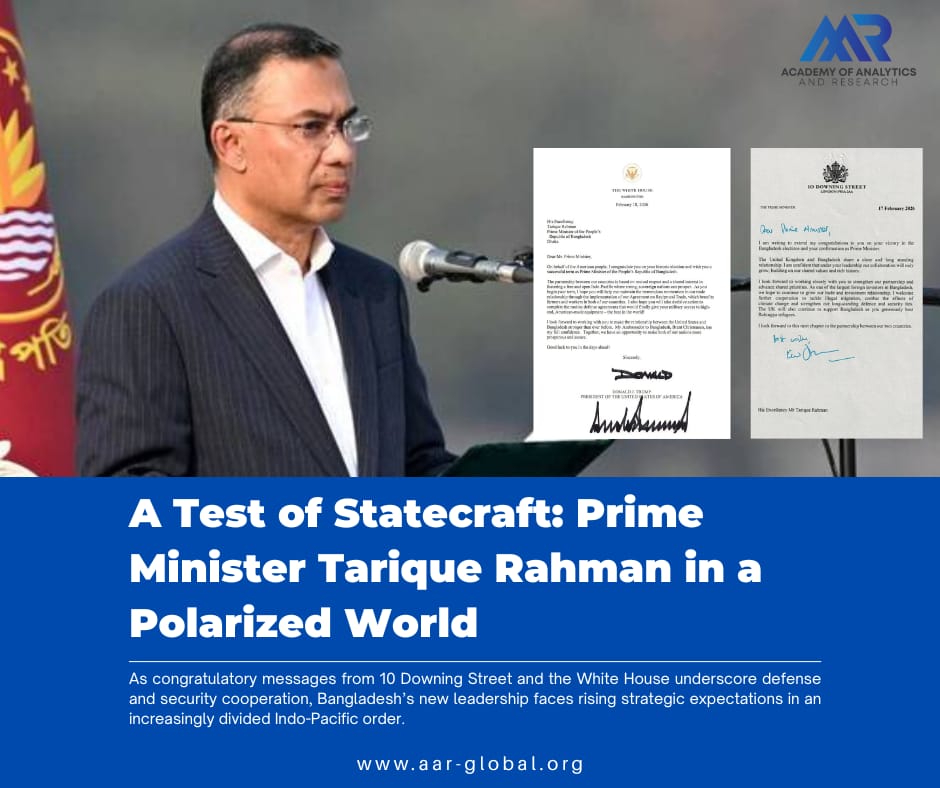
Recent congratulatory messages to Prime Minister Tarique Rahman from 10 Downing Street and the White House were not mere diplomatic courtesies. Both statements prominently emphasized defense and security cooperation. In international politics, such language is deliberate. When major powers foreground security in their first formal communications, they are signaling expectations — not exchanging pleasantries.
The United States has already clarified its strategic outlook through its Indo-Pacific framework. In Washington’s assessment, Bangladesh is no longer viewed solely as a developing economy; it is increasingly seen as a maritime stakeholder positioned at the northern gateway of the Bay of Bengal. American Indo-Pacific calculations revolve around securing sea lanes, balancing China’s expanding influence, and maintaining operational reach across the Indian Ocean. Geography therefore gives Bangladesh leverage — but it also places the country squarely within strategic calculations.
The United Kingdom, meanwhile, has referred to its “long-standing defense cooperation” with Bangladesh. Historically, London has maintained training partnerships, intelligence exchanges, and selective defense-industrial ties in South Asia. However, the tone of the recent message suggests renewed strategic interest not routine continuity.
When two major Western powers simultaneously emphasize defense cooperation at the outset of a new administration, it is not symbolic diplomacy. It reflects an effort to shape long-term alignment. To understand the broader strategic environment Prime Minister Tarique Rahman is stepping into, one must examine Diego Garcia, located in the Chagos Archipelago.
For decades, Britain exercised administrative control over the territory while the United States operated one of its most critical overseas military facilities there. This arrangement ensured operational stability without overt geopolitical friction.
That equilibrium has shifted. Following international legal pressure and sustained diplomatic negotiations, sovereignty over the Chagos Islands has been moved toward Mauritius. While operational agreements with the United States may remain in place, the legal and political landscape has changed in meaningful ways.
For Washington, this introduces uncertainty. Diego Garcia has been central to operations in the Middle East, South Asia, and broader Indo-Pacific surveillance missions. Any ambiguity surrounding sovereignty, basing rights, or long-term political alignment affects American force posture planning.
If Britain reduces its direct administrative role while Mauritius consolidates sovereign authority particularly at a time when China’s economic presence in the Indian Ocean is expanding, U.S. strategic planners must reassess long-term guarantees. In power politics, uncertainty compels preparation. When strategic ambiguity increases, major powers seek alternative access points, diversified partnerships, and stronger regional relationships. It is within this evolving landscape that Bangladesh’s importance rises.
During the Cold War, many developing nations including Bangladesh benefited from carefully calibrated neutrality by following british strategy. The formula was pragmatic, engaging multiple powers, avoiding binding commitments, and maximizing economic opportunity.
That environment is changing. The intensifying U.S.–China rivalry from Taiwan contingencies to maritime choke points is reshaping alliance structures, basing arrangements, and defense cooperation frameworks. In today’s environment, ambiguity is often interpreted as strategic hesitation.
As George Washington advised in his Farewell Address:
“It is our true policy to steer clear of permanent alliances with any portion of the foreign world.”
Washington’s warning was not isolationist. It was a reminder that sovereignty is best preserved through prudent engagement without entangling dependency. He understood that smaller states risk losing maneuverability when drawn too deeply into rival power structures.
However, strategic independence must be credible. A country that declares balance but lacks capability invites external pressure. A country that strengthens its institutions, diversifies its partnerships, and maintains clarity of purpose commands respect.
Bangladesh occupies a location that cannot be ignored:
• Northern access to the Bay of Bengal
• Proximity to vital Indian Ocean shipping lanes
• Connectivity between South and Southeast Asia
• Growing economic and demographic weight
This geography provides influence but also exposure. If U.S.–UK negotiations regarding Indian Ocean basing intensify, and if Washington seeks supplementary arrangements across the region to ensure operational flexibility, Bangladesh could find itself facing subtle but persistent diplomatic overtures.
Preparation in this context does not mean confrontation. It means strengthening national capacity so that engagement occurs on Bangladesh’s terms.
Under Prime Minister Tarique Rahman’s leadership, policy choices need not be binary neither passive neutrality nor unconditional alignment.
A forward-looking strategic approach could include:
• Strategic Autonomy Supported by Capability.
• Strengthen maritime surveillance, coastal defense, and airspace protection to ensure sovereign decision-making remains uncompromised.
• Diversified Defense Partnerships Avoid excessive reliance on any single supplier or bloc, thereby preserving negotiating leverage.
• Issue-Based Cooperation Participate in maritime security, humanitarian response, and counterterrorism initiatives without entering permanent military alliances that restrict flexibility.
• Broad Economic Engagement Expands trade and infrastructure cooperation across multiple global actors, raising the cost of coercive diplomacy.
When a state demonstrates preparedness, clarity, and resilience, external pressure loses its effectiveness. Major powers respect nations that combine openness with capability.
Great powers operate on interests, not sentiment.
If Bangladesh appears indecisive, it will face competing pressures. If it appears dependent, it risks strategic absorption. If it projects confident autonomy backed by institutional strength, it will be treated as a partner not a pawn.
The emerging Indo-Pacific order leaves diminishing room for rhetorical neutrality. Yet it still allows space for disciplined, interest-based independence provided that independence is structured, institutionalized, and supported by credible national capacity.
For PM Tarique Rahman, the coming years will determine whether Bangladesh converts its geography into leverage or allows it to become vulnerable.
The question is not simply which side to choose. The real question is whether Bangladesh will shape the regional equation or be shaped by it.
Author: Jaber Bin Obayed Ullah Chowdhury
Executive Director, Academy of Analytics and Research- AAR